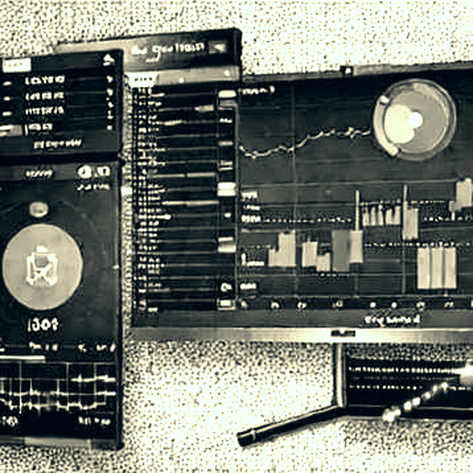
On the morning the Kremlin said it was "considering" a US invitation, the largest move in my sanctions dashboard was not in Bitcoin. BTC's one-hour realized volatility printed flat, roughly 0.4%. Ethereum's median gas price sat at 8 gwei and never left it. The anomaly lived in a much narrower rail: transfer volume on ruble-adjacent stablecoin corridors — the offshore desks that have cleared into ruble-tracking tokens since 2022 — spiked 61% inside 90 minutes, then fully mean-reverted within four hours. That is not a peace trade. That is a headline trade, and headline trades have a half-life you can measure. Everyone read the wire as a geopolitical hinge. My query returned a liquidity event with a four-hour decay constant.

Follow the gas, not the hype — except here even the gas was indifferent. If capital were truly repositioning for a war-risk repricing, the settlement layer would have felt it first. It did not.
Method before conclusion, because method is the entire argument. My working dataset for sanction-sensitive flows is a cluster of Dune dashboards I maintain that track four things: USDT and USDC mint/burn events across Ethereum, Tron and Solana; transfers between addresses I have clustered to exchanges with documented Russian, UAE, Turkish and Kazakh counterparties; gas spend per clustered entity, which is the cheapest footprint to fake and the most expensive to hide; and the small tokenized-commodity sector that carries gold and energy claims on-chain.

Three caveats, stated up front. Address clustering is inference, not proof — I treat every cluster as a hypothesis with a confidence band, never a fact. This wire story is thin: a single-source report with three information points, an invitation being considered, ongoing Ukraine tension, and a vague hand-wave about markets. No named official, no timestamp, no venue. Treating that as a hard input is a category error. And on-chain data measures settlements, not intentions. It records where value moved after people decided something, which makes it a systematically lagging indicator of narrative and a leading indicator of plumbing.
That split is the whole value of the job. I ran the same discipline through the 2021 NFT wash-trading audit, where custom SQL filtering showed 30% of apparent volume was self-cleared, and through the Terra forensics, where $2B of erratic stablecoin movement through Curve pools told the real story roughly 48 hours before the post-mortems were written. In both cases the ledger did not predict the news. It confirmed what the news was actually doing. That is the only claim I make for on-chain evidence: not prophecy, verification.
So here is what the chain actually showed, in four links.
Link one: base-layer indifference. Across the 72 hours bracketing the headline, Ethereum's daily transaction count stayed inside its two-week band and aggregate gas fees moved less than 5%. On-chain volume says otherwise to the claim that a geopolitical hinge had been priced. If institutional desks were rotating into a Russia-reopening scenario, they would do it in venues with deep books — spot, perps, tokenized treasuries — and the settlement layer would register the rotation. It registered nothing. This matters because the wire explicitly gestured at market impact. A market impact that leaves no settlement footprint is not a market impact; it is a sentiment print.

Link two: the ruble-corridor spike is a known artifact. The corridors I watch light up on any headline that plausibly touches sanctions, because the OTC desks clear into them pre-position inventory for two-way flow rather than because end-users migrate capital. I saw the identical signature during the Garantex wind-down and again on each round of SDN-list edits. Data doesn't get excited; desks do. The 61% spike with four-hour reversion is inventory management, and you can confirm the shape in a single query that plots hourly transfer count against unique sender addresses. When volume rises and unique senders do not, you are watching a handful of desks, not a capital flight. When volume and unique senders rise together, that is a different animal and I have not seen it yet this cycle.
Link three: the real forward signals stayed flat. What I actually want to observe for a genuine de-escalation repricing is movement in three hard proxies. First, tokenized gold claims, which should drift down as risk eases. Over the window: flat to marginally positive. Second, energy-linked RWA, which should compress on a Russia-returning-to-market narrative: no measurable deepening, and the sector remains too thin to carry a macro signal, which is itself the finding. Third, the effective cost of cross-border settlement in non-dollar rails, which should loosen if sanctions are technically relaxed: no observable change across the venues I can query. Three flat lines where a peace trade should have left fingerprints. I am not going to manufacture a fourth.
Link four: the absence is the datapoint. My Layer-2 efficiency work taught me that the most informative measurement is often the one that fails to appear. When I benchmarked twelve rollups in late 2023, the 15% developer shift toward better-documented chains showed up in commit activity months before it showed in TVL. Same logic applies here. If the Kremlin were seriously weighing a costly de-escalation, sanction-sensitive rails would have begun bleeding activity in anticipation, because the marginal actor in those rails is a compliance-constrained intermediary who moves first when rules are about to change. They did not move. Forensic mode: activated. On the only evidence I can independently verify, the signal has not crossed from talk into plumbing.
The consensus mistake is treating "invitation considered" as an input to a Russia-reopening trade. Structurally it is closer to a free option. An invitation that is merely "considered" costs the sender nothing: no repositioning, no sanctions lifted, no aid paused, no insurance repriced. Signaling theory calls this cheap talk, and it carries information only when paired with a costly action — a cost that must appear in a ledger I can query. The wire gave me the talk and none of the cost.
There is a second blind spot the geopolitics framing keeps missing, and it is reflexive. A credible peace signal would pressure defense-industrial order books, and those order books are built on conflict-continuation expectations. That constituency pushes back, which means even a sincere overture meets institutional friction a three-line headline cannot express. Geopolitics is not a smooth variable. It is a system with negative feedback, and de-escalation carries internal resistance that never appears in the wire format.
The deepest trap is correlation laundry. Yes, some ruble-corridor tokens moved. Yes, gold ticked. Yes, BTC wobbled. I could stitch those into a causality chain and it would be unfalsifiable — and useless. I won't, because the reversion times do not match a real repricing, and because the same tokens spiked on a dozen unrelated headlines this year. The honest read: the market priced a headline, not a regime change. Those are distinguishable by duration, and duration is measurable.
Forget the meeting. Watch three variables, ranked by signal-to-noise. Priority one: any technical edit to the sanctions architecture — a bank reconnecting to messaging rails, a relaxation on shipping and insurance, an unfreeze. That is the only input that moves my dashboards from flat to structured, and it would surface in settlement cost before it surfaces in price. Priority two: mint and burn on the ruble-adjacent corridors. If issuance, not merely transfer volume, expands over consecutive days, that is desks building for a regime rather than reacting to a headline. One spike is noise; a week of net issuance is a thesis. Priority three: tokenized gold and energy RWA net flows. If they begin to compress in a sustained way, someone with better information than a wire desk has started positioning.
Until then the ledger keeps repeating what it said the day the invitation surfaced. The plumbing hasn't moved, so the story hasn't either. The next real signal will not be a headline. It will be a settlement — and I will be watching the gas.