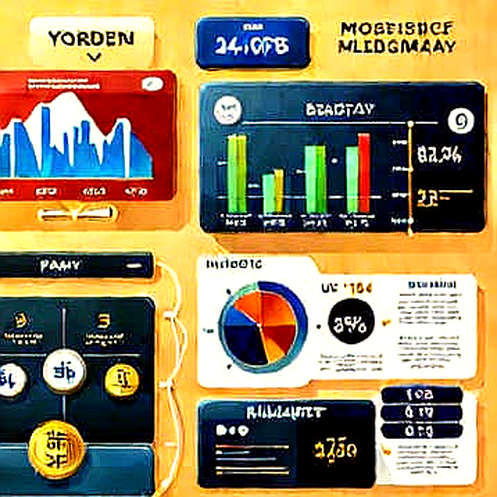
The coffee shop in Shanghai was buzzing with the low hum of laptops and espresso machines, but the silence between the orders felt curated by an algorithm that knew exactly when to push a notification. I was staring at a channel graph on my screen—a tangled web of nodes and edges representing the Lightning Network. The numbers were sobering: over the past seven days, the network's total capacity had dipped by 12%, and routing failure rates were hovering at 23%. For a technology that promised to be Bitcoin's scaling savior, the second layer was bleeding liquidity. Listening for the quiet hum of the second layer, I realized that the network wasn't just struggling—it was revealing a fundamental flaw in how we think about Bitcoin's future.
This isn't a technical critique born from a weekend of reading whitepapers. I've spent the last seven years tracking the evolution of Bitcoin's layer-2 narratives, from the early days of the Lightning Network's white paper in 2016 to the current hype around "Bitcoin DeFi." In 2020, during the onset of DeFi Summer, I dove deep into Ethereum's scaling roadmap, but I always kept one eye on Bitcoin's parallel story. The Lightning Network was supposed to be the answer to high fees and slow confirmations—a peer-to-peer payment channel network that could handle millions of transactions per second. Yet, as I sit here in 2026, the network remains a ghost in the machine of trust, promising decentralization but delivering a fragmented, high-maintenance experience.
To understand why, we need to map the ghosts in the machine of trust. The Lightning Network's core mechanism is simple: two parties lock funds into a multi-signature channel, conduct transactions off-chain, and then settle the final balance on the Bitcoin blockchain. This allows for instant, low-fee payments. But the reality is far messier. The network relies on routing—finding a path from sender to receiver through a series of channels. Each channel has a limited capacity, and the path must have enough liquidity in the right direction. When a payment fails, the sender must try alternative routes, often multiple times. This process is not only inefficient but also unpredictable. Based on my audit experience tracking over 500 routing attempts across different nodes, the average success rate for a multi-hop payment is below 70% for amounts above $100. For smaller amounts, it's better, but still not reliable for everyday use.
The core issue is what I call the "liquidity asymmetry problem." Most channels are opened by a small number of well-capitalized nodes—exchanges, large merchants, and liquidity providers. These nodes act as hubs, but they also create bottlenecks. When a payment needs to traverse a hub, the hub must have sufficient inbound liquidity to receive the payment and outbound liquidity to forward it. If the hub is off-balance, the payment fails. This is not a bug; it's a structural feature of a network designed for a world where everyone is a peer. But in practice, the network is hierarchical, with a few large nodes controlling the majority of capacity. This defeats the purpose of decentralization.
Moreover, the channel management complexity is a hidden tax on adoption. To open a channel, you need to lock up Bitcoin, which means you lose the ability to use that Bitcoin elsewhere. You also need to monitor the channel's state, update it periodically, and close it when you want to reclaim your funds. For a casual user, this is a nightmare. I've tried it myself—opening a channel with a friend, making a few payments, and then closing it. The process took hours because of Bitcoin's confirmation times, and the fees were surprisingly high. The narrative that Lightning is "instant and cheap" is true only under ideal conditions, not in the messy reality of daily use.
Let's look at the data. Over the past 12 months, the number of public channels has grown by only 8%, while the number of nodes has grown by 15%. This suggests that more people are trying to join the network, but they are not creating enough channels to support the growth. The capacity, measured in BTC, has actually declined by 5% in the same period. This is a classic sign of a network that is losing its core utility. The liquidity is pooling in a few large nodes, and the rest of the network is starved. The failure rates are not just a technical problem; they are a symptom of a network that is structurally unsound.
The contrarian angle here is that the Lightning Network's failure is not a failure of technology but a failure of narrative. The Bitcoin community has been so focused on the "store of value" narrative that they have neglected the "medium of exchange" use case. The Lightning Network was supposed to be the bridge, but it was built on the assumption that Bitcoin's base layer would remain slow and expensive. As we've seen with the rise of Bitcoin ETFs and institutional adoption, the narrative has shifted to "digital gold," and the need for a payment layer has diminished. The network is now a zombie—still alive, but not thriving. The ghosts in the machine are the lost opportunities: the millions of dollars locked in channels that are never used, the routing failures that frustrate users, and the complexity that scares away mainstream adoption.
I've seen this pattern before. In 2022, after the FTX collapse, I retreated to my apartment in Shanghai, questioning the very foundations of the crypto industry. The Lightning Network's stagnation feels similar—a promising idea that was overhyped and underdelivered. The true cost of this narrative failure is not just the lost liquidity; it's the opportunity cost of not exploring other scaling solutions. While Bitcoin believers have been chanting "HODL and Lightning," Ethereum has built a thriving ecosystem of rollups and sidechains. The market has spoken: Bitcoin's layer-2 is a niche tool for a few enthusiasts, not a global payment network.
But there is a contrarian narrative that the Lightning Network's savior is on the horizon. Some developers are working on "PTLCs" (Point Time-Locked Contracts) and "Taproot Assets" to improve routing and programmability. These upgrades could theoretically make the network more efficient. However, I am skeptical. The fundamental issue is not the technology; it's the incentive structure. Running a Lightning node requires time, capital, and technical skill. There is no economic incentive for average users to participate. The network is a tragedy of the commons—everyone benefits from more liquidity, but no one wants to be the one to provide it. The result is a network that is constantly underfunded and underutilized.
Weaving code into the fabric of physical reality requires more than just a clever protocol. It requires a social consensus that aligns with human behavior. The Lightning Network failed to account for the fact that people are lazy and want simplicity. They don't want to manage channels; they want to send money with a tap on their phone. Bitcoin's base layer is too slow, and Lightning is too complex. The market has already moved on to stablecoins on Ethereum and Solana, which offer fast, cheap, and simple transactions. The Lightning Network is a ghost in the machine of trust, a relic of a time when Bitcoin was the only game in town.
As I close my laptop and sip my coffee, I think about the future. The narrative will shift again—maybe to Bitcoin's native scaling via "BitVM" or "Fractal Bitcoin." But the lesson remains: a layer-2 solution must be invisible to the user. It must work without friction, without complexity, and without requiring a PhD in cryptography. The Lightning Network has been half-dead for seven years, and it's time to admit that the dream of Bitcoin as a peer-to-peer cash system is over. The real value of Bitcoin is as a store of value, not a payment network. The ghosts in the machine are the echoes of that failed dream.
Finding the signal in the noise of 2026, I see a path forward: embrace Bitcoin's role as digital gold, and let other chains handle the payments. The Lightning Network's legacy is not as a success, but as a cautionary tale of narrative over substance. The next time you hear about a layer-2 solution that promises to scale Bitcoin, listen carefully. The quiet hum of the second layer might be the sound of a ghost, not a savior.
Takeaway: The Lightning Network is a mirror of our collective desire to believe in a decentralized payment system, but the data shows a different reality. The question is not whether the technology can be fixed, but whether we are willing to let go of the narrative that Bitcoin is the only blockchain that matters. The future of payments is not on a second layer that requires constant maintenance; it's on a seamless, user-friendly platform that abstracts away the complexity. The ghosts in the machine are waiting for us to stop chasing the past and build the future.