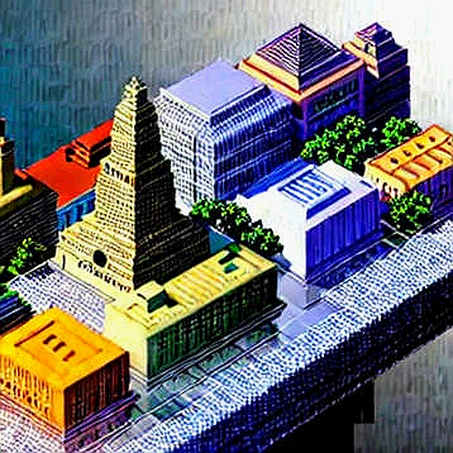
The Sky Is No Longer a Witness: Google's Satellite Deepfake Pull and the Verification Economy
Google pulled "Nano Banana" from public access in under twenty-four hours. The tool — a text-to-image generator built for geospatial scenes — had been quietly made available to a limited set of users, and then just as quietly killed, after investigative journalists and open-source intelligence researchers flagged the obvious catastrophe: the model could fabricate photorealistic satellite imagery from nothing but a text prompt. Type in coordinates. Specify a weather pattern. Set a date and a timestamp. The model hands you a synthetic image carrying the same visual authority as a genuine orbital capture. Emergency response. War documentation. Environmental litigation. All of it, suddenly and invisibly, forgeable.
The code doesn't lie. It renders the world you ask it to render. If you typed "troop convoy massing near border checkpoint, morning fog, 06:15 local," the output would land on a briefing table with the visual grammar of hard intelligence. Fake, yet indistinguishable from captured. The distinction, it turns out, is not a technical property embedded in the image itself. It is a social convention layered on top of the image. And conventions, as every market participant knows, can break faster than they can be rebuilt.
Tracing the alpha through the noise of consensus: the prevailing market read treats this as a Google governance wound, a responsible-AI containment story followed by an apology memo and a redesigned approval process. I read it as something else. I read it as the opening chord of a sector-wide repricing across AI infrastructure, media forensics, and — yes — blockchain. The last universally trusted oracle of the physical world has just been demonstrated to be forgeable. Not by a sophisticated nation-state intelligence operation. By a text prompt.
Satellite imagery has always occupied a privileged position in the information hierarchy. Unlike a grainy phone video or an anonymous tweet, a satellite photograph carries the weight of physics — an orbital platform, calibrated sensors, a precise clock, a coordinate grid. Investigators at institutions ranging from the New York Times visual desk to the International Criminal Court use it to corroborate mass graves, verify troop movements, track refugee flows, and document environmental crimes. It does not merely report reality. It is treated as reality.
In blockchain terminology, this is an oracle: a feed that carries external truth into a system of consequential decisions. And I have spent a career watching what happens to people who assume oracles are unattackable. In my early years auditing DeFi protocol economics, I documented how a single compromised price feed could drain a hundred million dollars in one block. The flash-loan oracle attacks of 2020 and 2021 were the signature exploits of the industry's adolescence. The response became a multi-billion-dollar verification industry: decentralized oracle networks, staking guarantees, cross-referencing schemes, and cryptographic attestations. The lesson burned into every survivor of that era is simple. Truth is only as robust as its verification layer. If you cannot verify a claim, you cannot price it. And if you cannot price it, you cannot safely build on top of it.
Google Earth became the oracle of the physical world. Twenty-plus years of feeding petabytes of genuine satellite data into the most authoritative map of the planet ever assembled. Disaster response teams route around it. Militaries plan with it. Courts accept its imagery as evidence. The public concedes it the default status of objectivity. Nano Banana attacked that consensus at its root. It demonstrated that the visual grammar of satellite imagery — the disciplined terrain contours, the geological textures, the longitude-dependent shadow geometry — can be synthesized from statistical patterns alone. The product was pulled within a day. The proof of concept is permanently public.
This is not merely a Google failure, though it is also that. It is a structural event. A generation layer that the geospatial industry believed to be scarce, expensive, and therefore trustworthy has been commoditized into noise.
Let me strip away the drama and look at the machinery. Nano Banana appears, from every available signal, to be a diffusion model fine-tuned on geospatial data — very likely built atop Google's Imagen or Gemini visual stack, tuned on the enormous archive of real satellite imagery the company has accumulated. The technical route is not exotic; it was inevitable. Satellite imagery is an almost embarrassingly good training domain. Unlike the chaotic, semantically unbounded space of general photography, orbital imagery is rigorously disciplined. Terrain follows known geological constraints. Agricultural regions sit in regular grids. Urban development obeys density gradients. Shadows follow solar angles computable from latitude and time. The Earth seen from above is far more regular than the Earth seen from human height. Diffusion models thrive on regularity. They learn distributions, and the distribution of the Earth's surface is as learnable a manifold as exists.
But the mechanics of generation are only half the story. The more telling fact is what was missing from the product: authentication. Google possesses SynthID, its watermarking and detection system for AI-generated content — one of the best in the industry. Yet this tool shipped without adequate geo-specific safeguards, or without SynthID enforced across all generated outputs. The failure is not one of technical capability. It is one of risk classification. Google's safety review almost certainly checked the standard categories: violence, hate, sexual content, disinformation. But no established rubric contains a category for "geospatial misinformation." The checklist covered every harm the reviewers had names for. The unnamed harms shipped.
I have a personal reference point for this. In 2017, as a twenty-one-year-old mathematics undergraduate in Nairobi, I spent four months manually verifying the gas cost models in the Ethereum whitepaper. The market was swept up in ICO euphoria, convinced of the paper's inevitability. The formalism, when you lined it up against the state transition function's actual constraints, contained disturbing inconsistencies around computational pricing. What I learned from that exercise has shaped every analysis I have done since: consensus and correctness are mathematically orthogonal. And institutions rarely perform the audit that would reveal the gap between them. The market narrative is the last thing you should audit. The code — or the model, or the data pipeline — is the first.
This is precisely the mindset I recommend applying to satellite imagery. The analytical tradition of treating orbital images as a neutral record is ending. Not because all satellite images will be fake. Because the cost of faking them has gone from astronomical to negligible, and because the institutions that consume them so far have no systematic way to distinguish captured from synthesized. A fabricated image that survives human review is not the primary threat. The primary threat is the middle of the distribution: images plausible enough to pass routine checks, carrying metadata that looks structurally identical to authentic capture records. This is where the forger's advantage becomes overwhelming.
The DeFi analogy deserves to be pushed further. Oracle attacks were rarely glamorous. A flash loan, a manipulated AMM, a single mispriced asset — the conditions were unglamorous, even tedious. But the economic damage was catastrophic precisely because the market trusted the feed. Similarly, the threat here is not an adversary shouting a lie. It is an adversary who quietly knows that every institution consuming satellite imagery is operating without a verification layer. The manipulation surface is not the image itself. It is the empty space between the image and anything that could prove it real.
Consider where the verification technology actually stands. C2PA — the Coalition for Content Provenance and Authenticity — has spent years engineering standards for cryptographically signing content at the point of capture. Truepic and Attestiv have built hardware-anchored verified-capture pipelines for consumer and commercial photography. None of this has been integrated into the orbital imagery supply chain in any meaningful way. A Maxar image typically carries basic telemetry — capture time, coordinates, sensor ID — but nothing that a determined attacker cannot replicate on a synthetic output. The standards exist, the cryptography exists, the market incentive now exists. What is missing is the connector: a unified provenance protocol that treats satellite sensors as trusted hardware modules, signs every frame at the source, anchors the signature to a tamper-resistant ledger, and makes verification a one-step operation for any downstream consumer. This is a blockchain infrastructure problem disguised as an AI safety problem.
Let me now follow the incentives, because they are about to redistribute. In the short term, Google takes a reputational hit with limited financial damage. Its refusal to let a product with catastrophic misuse potential stand is, paradoxically, a signal that enterprise and government customers will price as a positive. Microsoft and OpenAI pick up on the scent. Bing Maps has never matched Google's geospatial moat; a modular AI generation layer with rigorous provenance controls could position them as the responsible default for institutions that now look at Google Earth with a newly suspicious eye.
The mid-term winners are the specialized sensor operators. Planet and Maxar fly satellite constellations of their own, and they have spent years monetizing the authenticity of their capture infrastructure. Their economic moat is precisely the physicality of their operation: a satellite took this image, and its sensor telemetry can prove it. In a world where synthetic imagery is cheap and verified physical capture is scarce, provenance becomes the premium product. Esri, the dominant GIS platform, faces a grayer risk: as an aggregator of spatial data rather than a primary sensor operator, its credibility depends on the credibility of the data it processes. The entire geospatial software stack will need to be retrofitted from a visualization system into a provenance system.
But the dark side of the competitive forecast is the open-source ecosystem. The capability Nano Banana demonstrated is reproducible by fine-tuning an open-weight diffusion model on publicly available satellite data. That data is not secret. Academic archives, government open-data platforms, commercial sample sets — enormous quantities of real orbital imagery are already in the public trust. A determined team with sufficient compute could ship an unrestricted derivative within months. Google's decision to pull the tool is a responsible act. It is also functionally irrelevant to the long-term diffusion of the underlying capability. Every rug pull has a pre-written script, and this one is easy to read: create the tool responsibly, demonstrate the capability, and let the inevitable fork carry it into the wild with no guardrails at all.
This is where my current research — the interaction of autonomous AI agents with blockchain oracles — gives me an unusually specific lens. Consider a scenario I have been modeling for clients: ten thousand AI agents ingesting satellite imagery feeds to make trading, logistics, and insurance decisions. If even a small percentage of the images in those feeds are synthetic, the entire downstream decision layer is poisoned. The manipulation surface shifts from human perception to algorithmic trust. And algorithms have no instinctive skepticism, no pattern of lingering doubt. They consume what they are fed. The behavioral geometry of this failure is fractal: a small lie in the data layer compounds into a large misallocation across every system built on top of it. The machine-to-machine narrative economy I have been tracking for the past two years now collides directly with geospatial infrastructure. Whoever solves the verification problem for physical-world inputs first will be the infrastructure provider of the agentic era.
Now the red-team turn, because the obvious conclusion is rarely the complete one. The most dangerous long-term effect of this episode is not that fake satellite images will circulate. It is that authentic imagery will become credibly dismissible. I call this the liar's dividend. A government accused of a massacre responds: "That's an AI-generated deepfake. You cannot prove it is not." A corporation facing pollution charges makes the same argument. The burden of proof shifts to the party seeking justice. And the cost of proving authenticity just rose while the cost of denying it collapsed. This dynamic will cause far more damage than any single fabricated image that might be published in the coming years.
The uncomfortable implication is that Google's decision, while ethically correct, was simultaneously a perfect smoke screen for the systemic problem. Killing the product creates the appearance of containment. It does not contain the technology. The diffusion model is open; the fine-tuning dataset is available; the compute is purchasable. The more loudly Google declares its responsibility, the more it entrenches the assumption that responsibility at the source solves the problem. It does not. The capability has already propagated.
So the contrarian investment thesis is not the simple "AI is dangerous, therefore back safety." It is subtler. In a world where synthetic media is cheap and unavoidable, the premium shifts to anything that can prove physical origin. Cryptographically signed capture protocols. Hardware-rooted attestation in satellites and drones. Decentralized registries where imaging devices register their identities and their outputs are anchored to tamper-resistant ledgers. This is not speculative infrastructure for a distant future. It is the necessary condition for every institution that depends on knowing what actually happened on the surface of the Earth.
The era of "trust the picture" is ending. It is being replaced by the era of "verify the claim" — and the gap between those two postures is the largest alpha of our generation. The contest between synthetic reality and provable truth will define the next decade of infrastructure investment across media, geospatial intelligence, and crypto's quiet expansion into physical-world verification. Decentralization is a spectrum, not a switch, and truth is the same way: not objective by default, but objective when verification makes it so.
The opportunity hides in the edges of the norm. Every newsroom, every courtroom, every intelligence desk on the planet needs a verification layer it does not yet have. The sky no longer testifies. Only the signature does. And the difference between those two words — testimony and signature — will be the widest margin of this generation.
You May Like
The $1.25 Trillion Phantom: How a Prediction Market Lie Reveals Crypto Media’s Cognitive Dissonance
2026-07-19
The Great Unraveling: What the High Beta Crash of July 2025 Reveals About Our Decentralized Future
2026-07-18
The Story We Sold Ourselves: Why Crypto’s 'Real World' Connection Is Hollow
2026-07-16
The 4% Signal: What SpaceX's Nvidia "Exclusivity" Actually Tells Us
2026-08-09
When Micron Sank, So Did Its Token: The RWA Diversification Myth Exposed
2026-07-16
EIP-8222: The STARK Privacy Proposal That Could Break Ethereum Staking
2026-07-24
The Dalio Mirage: Why Celebrity Endorsements Don't Move Bitcoin's Liquidity
2026-08-22
Hormuz on Paper: Trump's Cheap Talk Is the Real Trade in Bitcoin Right Now
2026-08-04
Pump.fun's $10M Weekly Revenue Milestone: A Signal of Retail Dominance or the Top of the Memecoin Cycle?
2026-08-25
Crypto Briefing's Community Shield Article: A Missed On-Chain Opportunity or a Strategic Pivot?
2026-08-16
Backpack’s 24/7 Stock Market: The Regulatory Trap Behind the SpaceX Illusion
2026-07-11
Nexus Rollup: The Sequencer Illusion – A $200M Trap
2026-08-20
The Noise Tax: How Empty Content Distorts Crypto's Macro Signal
2026-08-15